Anotaciones
La Pictorial Library of Bible Lands incluye amplias notas con descripciones y explicaciones. Para poder utilizar estas anotaciones en conjunto con las imágenes, hemos decidido utilizar la sección de “Speaker’s Notes” en los archivos PowerPoint.
Nota: Esto brinda la ventaja adicional de poder ser utilizado a través de diferentes plataformas de operación (p. ej., Mac), pero requiere que el usuario tenga una versión completa del programa PowerPoint u otro programa compatible (p. ej., la versión gratis de OpenOffice).
Las anotaciones son el resultado de muchos años de investigación y llegan a un total de más de 2000 páginas. No todas las imágenes tienen anotaciones. En unos casos solo la primera imagen de un grupo tiene una explicación ya que las otras imágenes son del mismo tema. En otros casos, no se hicieron anotaciones de ciertos temas por debido a la falta de tiempo.
Aquí se muestran algunos ejemplos de las explicaciones históricas, geográficas y arqueológicas dadas a las imágenes. Cabe aclarar que estas notas no son el total que usted verá de un tema en particular, pero son las asociadas con esta imagen específicamente. Por ejemplo, hay docenas de fotos de la sinagoga de Capernaun pero hay notas diferentes para cada una de las imágenes.
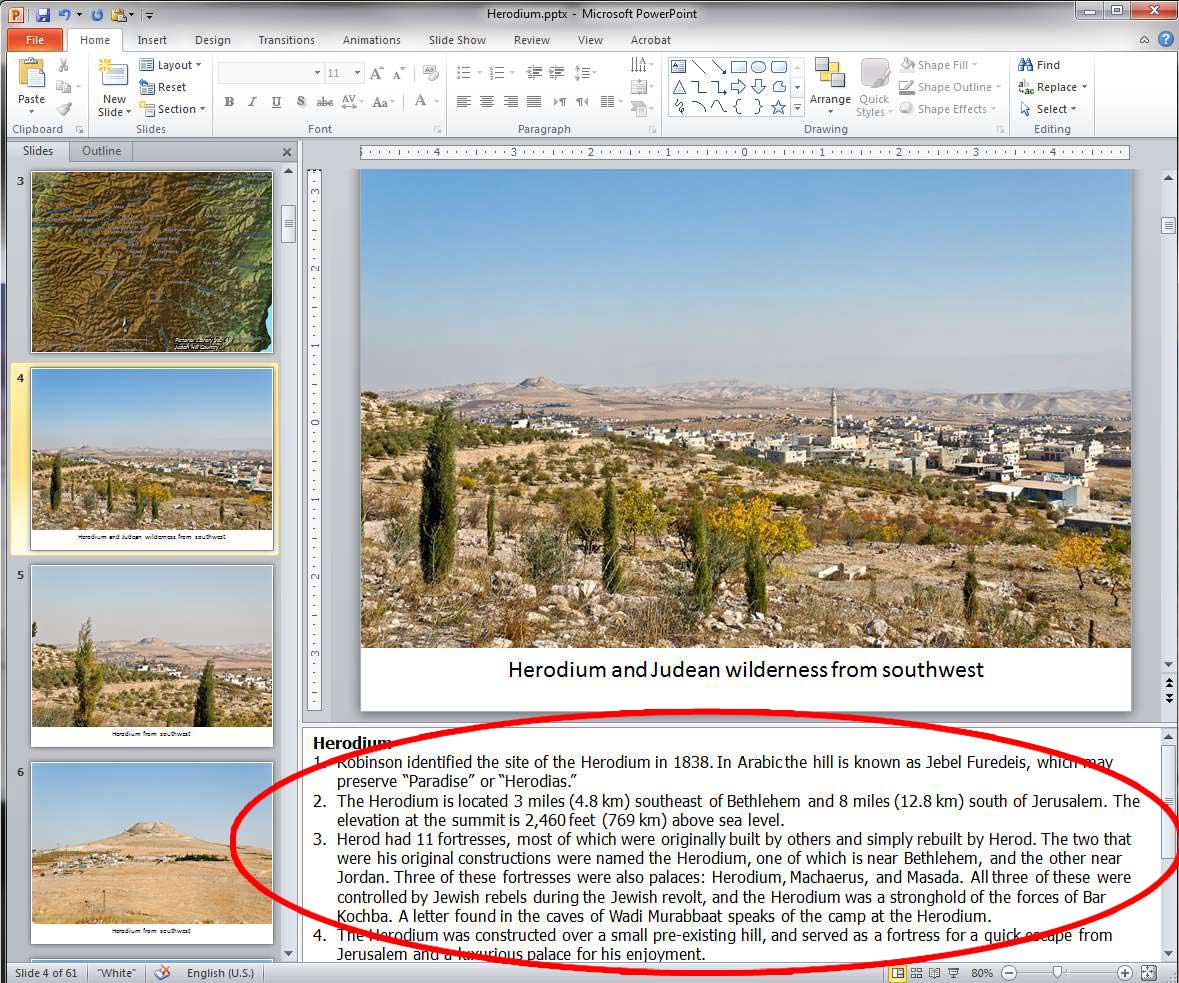
Captura de pantalla Juda y el Mar Muerto:
Click on image for large version
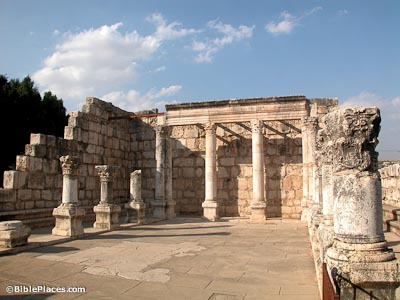
Interior of the Capernaum Synagogue
- Benches on which the elders sat lined the inside wall. There were probably mats on the floor inside the synagogue for people to sit on (Strange and Shanks 1983: 26).
- The architrave was originally a single piece of limestone, but it has been broken.
- The corner columns are heart shaped.
- The synagogue in Capernaum is a typical Galilean synagogue.
- The doors face Jerusalem and the worshippers prayed in that direction. The Torah must have been wheeled around to the door area (see the inscription found with Torah on a cart). Later synagogues have doors which are located on the opposite side from Jerusalem.
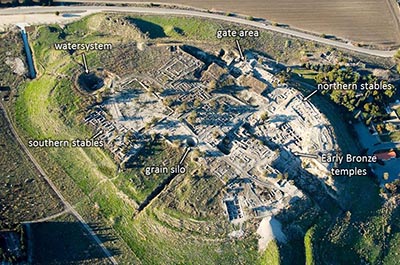
Solomonic Gate at Megiddo
Megiddo: Brief Archaeological History
- Megiddo has approximately 26 levels of occupation. The first inhabitation was during the Chalcolithic period, but only a few segments of houses have been uncovered. The earliest fortified city dates to the Early Bronze Age.
- Like other cities at the time, Megiddo in the Middle Bronze period had a lower city at the foot of the tell. Not much is known about it because the American excavators unknowingly placed their excavation camp on top of the lower city.
- During the Late Bronze Age, the kings of Megiddo were wealthy, as attested to by a collection of gold implements, ivory ornaments, and necklaces of gold and lapis lazuli found in Level VIII. A collection of more than 200 ivory plaques without parallel in archaeology of this country were found in Level VII (13th-12th centuries BC).
- The Solomonic city was destroyed by Pharaoh Shishak. A fragment of a victory stele erected by Shishak found at the site is now on display in the Rockefeller Museum in Jerusalem.
- Megiddo fell to the Assyrians in 733 BC.
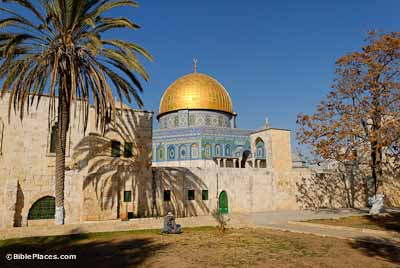
The Dome of the Rock
- The inner dome of the Dome of the Rock is original and is made of wood.
- The structure had a lead dome from 691 to 1965.
- The oxidized copper dome, which looked like gold, was installed by King Ibn Saud in 1965. This was one of the things done in reaction to the Pope’s visit to Jerusalem in 1964.
- The copper dome was replaced by King Hussein (with money from Saudi Arabia) in the 1990s with one of pure gold, because the existing one was rusting and needed to be replaced. “In 1994 a new gold-plated exterior dome, weighing a total of 80 kilograms [180 lbs.], was installed at a cost of $15,000,000. The plating is not more than .0023 mm thick, and the sheen of the gold was slightly muted during the plating so that the dome would not blind anyone gazing upon it” (Meiron 1999: 154).
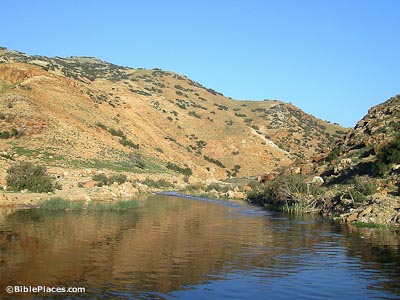
Jabbok River
- Sihon was defeated “from the Arnon to the Jabbok” (Num 21:24).
- In general, Reuben and Gad settled south of the Jabbok, as far as the Arnon, and half of Manasseh settled north of the Jabbok (Deut 3:12-17; Josh 13:31). The Gadites, however, seem to be found wherever there is Israelite settlement in the Transjordan, including the area north of the Jabbok River.
- The Jabbok River split Upper Gilead in two, thus the references to “half Gilead” (Josh 12:2, 5).
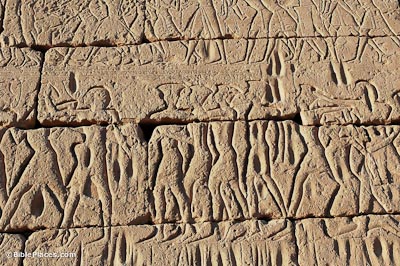
The Philistines depicted at Medinet Habu
- The Philistines are known by their feather head dress.
- The Philistines can be recognized because of their use of swan decorations, two-edged swords, spears, and rounded shields. The Egyptians on the other hand, used sickle swords and tombstone shaped shields.
- Philistine women and children are shown in ox-driven carts, indicating that the Sea Peoples were not only military invaders, but migrants.
- The majority of the Sea Peoples are clean-shaven, but a few Philistines are depicted with beards.
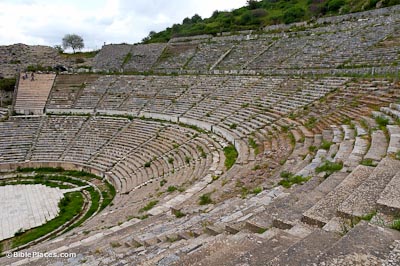
The Great Theater of Ephesus
The Great Theater of Ephesus was an important part of city life in Ephesus being on the route of the Artemis procession. After its completion by the Romans it seated 25,000 people. The existence of the theater can only be verified after 100 BC but it is likely it began in 133 BC with the establishment of the province of Asia. It most likely went through several stages of enlargement which were completed by AD 262 when part of the theater collapsed in an earthquake.
Acts 19:29, 34b; 20:1 (KJV) “And the whole city was filled with confusion: and having caught Gaius and Aristarchus, men of Macedonia, Paul’s companions in travel, they rushed with one accord into the theatre. . . all with one voice about the space of two hours cried out, Great is Diana of the Ephesians. . . And after the uproar was ceased, Paul called unto him the disciples, and embraced them, and departed for to go into Macedonia.”
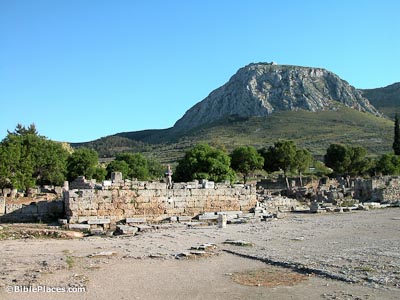
Bema at Corinth
The Roman tribunal where Paul was dragged before Gallio has been uncovered in the center of the agora. This was the bema, where Roman officials would appear before the public. In Delphi, an inscription mentioning riots in Achaia and Gallio’s name serves to date Gallio’s proconsulship to between AD 51 and 52. Had Paul’s trial been more formal, it likely would have been held at the North Basilica instead of the Bema. In Christian times, a church was built atop the bema.
Acts 18:12 (KJV) “And when Gallio was the deputy of Achaia, the Jews made insurrection with one accord against Paul, and brought him to the judgment seat.”
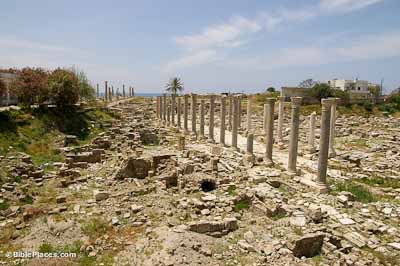
Tyre, al-Mina site, Roman agora
Tyre in the New Testament
- Some people from the area of Tyre came to hear the preaching of Jesus (Mark 3:8; Luke 6:17).
- Jesus sought refuge from the Jewish crowds in the vicinity of Tyre (Matt 15:21; Mark 7:24).
- Jesus claimed that if the miracles performed in Chorazin and Bethsaida and been performed in Tyre and Sidon, the two pagan cities would have repented (Matt 11:21-22; Luke 10:13-14).
- Herod Agrippa I died shortly after making peace with the people of Tyre and Sidon (Acts 12:20).
- Paul spent a week in the city of Tyre on the return from his third missionary journey. The believers in the city urged Paul not to continue on to Jerusalem (Acts 21:3-7).